4–5
Semester 6
6–10
The Free Radical and Radiation Biology Program puts students in the lab from day one. Our PhD program pairs hands-on research experience with rigorous training in scientific writing and oral communication — giving graduates the skills to compete for funding, publish high-impact work, and lead in academic and industry careers.
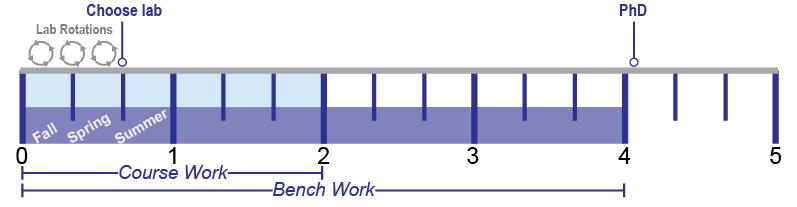
The FRRB graduate program is built around two priorities: producing original, high-quality research and training students to communicate that work clearly and confidently.
Students are expected to be in the lab from day one. That early hands-on experience isn't just about learning techniques — it shapes how students think about what's actually achievable, which makes for stronger, more realistic research proposals down the line.
The program is designed to move efficiently. The goal is PhD completion in 4 to 5 years, with most students finishing closer to 4. To stay on that track, students complete their PhD Comprehensive Examination no later than the start of their sixth semester. The exam takes the form of an NIH R01-style research proposal — with preliminary data — covering the work they plan to pursue for their thesis.
Written and oral communication are woven throughout the entire program, not treated as an afterthought. Students complete regular written assignments, deliver formal public seminars with immediate faculty feedback, present research progress in informal settings 6 to 10 times over the course of their degree, and lead journal club discussions. Poster presentations at on-campus forums each year build the foundation for presenting at national and international scientific meetings — which all students are actively supported to do.
It all adds up to graduates who are ready to hit the ground running.
What you'll develop
Written communication
A series of written assignments and required research reports builds progressively toward the comprehensive exam — a full NIH R01-format research proposal, complete with preliminary data, submitted no later than the start of the sixth semester.
Research skills
Students enter the lab from day one. This early immersion builds a realistic foundation for research — helping students understand what questions can actually be answered before a single proposal is written.
Oral presentation
Students deliver multiple formal public seminars that are critiqued immediately by program faculty, present research progress in 6–10 informal settings throughout their graduate career, and lead several journal club discussions.
Conference experience
Students are encouraged to submit poster presentations to 2–3 on-campus research forums each year. The FRRBP Program actively supports every student in presenting their work at appropriate national and international scientific meetings.